


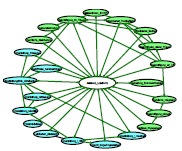
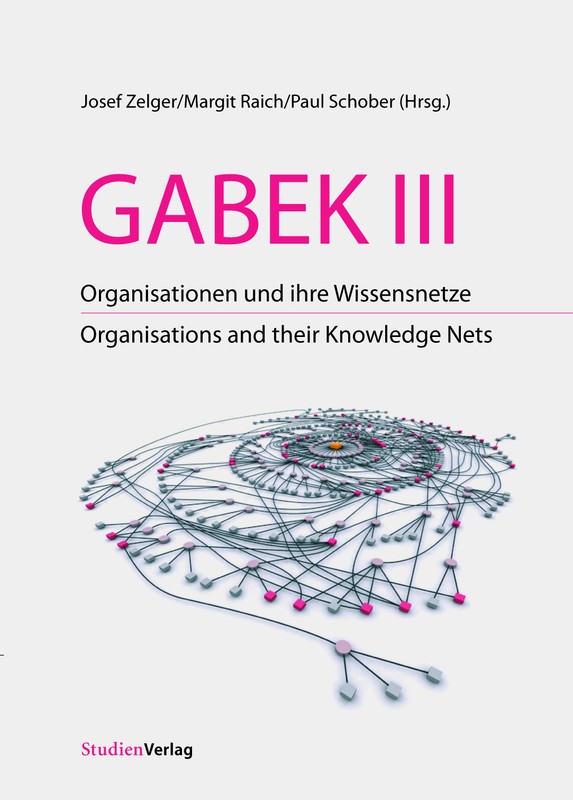
In order to understand an organization, people’s relationships with each other, their knowledge, basic beliefs and goals must be perceived and understood. This is the purpose of the GABEK® procedure (complete management of complexity). It allows a representation of conceptual and knowledge networks of an organization and their interpretation.
News
Learning and Development in Organizations
Learning and Development in Organizations
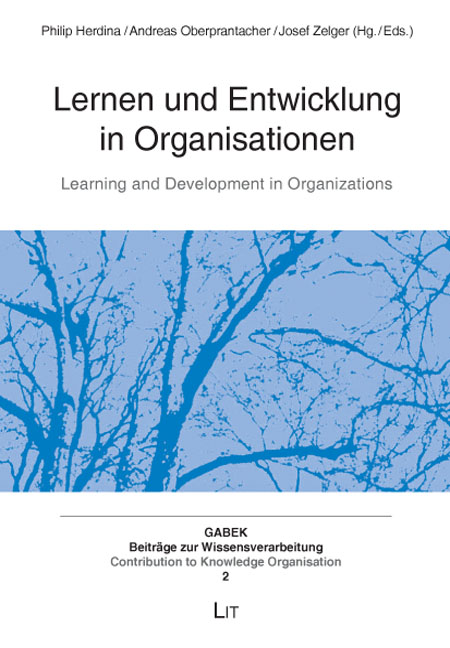
Favorable organizational development requires learning processes of organization members. To stimulate learning processes, one can start from the experience that the affected persons have had. Experience consists in the networking of perceptual, evaluation and knowledge elements, which has proven itself in many different situations. For this reason, the present volume shows how networks of perceptual, evaluation and knowledge elements can be analyzed and represented by the GABEK method.
GABEK® training at the FH Salzburg
Business & Information Management

On the initiative of Ass.-Prof. (FH) Mag. (FH) Johanna Lengauer - Assistant Professor Marketing, a 3-day basic training in the GABEK procedure took place at the University of Applied Sciences Salzburg - bwi Business & Information Management.
Humanities researchers at LFU Innsbruck cooperate with Vorarlberg companies
Acquisition of experience

GIKO is a highly technical company in the packaging industry in Vorarlberg. The techn. Head Angelo Zaffignani has gained experience in the company for more than 42 years. In order to preserve this experience, members of the philosophical-historical [...]
Study on German teaching presented at Italian schools
GABEK® curriculum evaluation
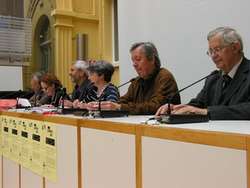
After more than ten years of the curriculum, the Pedagogical Institute for the Italian Language Group has initiated a reflection on the value and status of this curriculum with its own project. The project was developed by the pedagogical staff of the Institute Klaus Civegna and Univ.-Prof. Siegfried Baur. Univ.-Prof. Dr. Josef Zelger conducted a GABEK evaluation of the curriculum.
GABEK® advanced course in the Rhineland
Office for Rhineland Regional Studies of the Rhineland Landscape Association
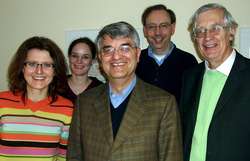
On 29.-31. In March 2006, an advanced course for special GABEK applications took place in the Rhineland Regional Office.
GABEK at the INTERNATIONAL FORUM ON THE SOCIAL SCIENCE – POLICY NEXUS in Buenos Aires
GABEK: Linguistic Processing of Complexity
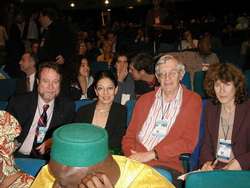
At the invitation of UNESCO to the INTERNATIONAL FORUM ON THE SOCIAL SCIENCE - POLICY NEXUS in Buenos Aires (20-24 February 2006) Prof. Josef Zelger gave a lecture on "GABEK: Linguistic Processing of Complexity"
GABEK® training at Ljubljana University
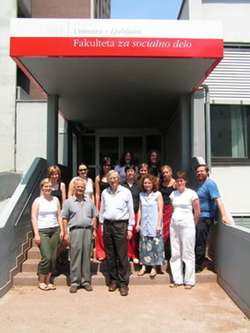
From 20-23 June 2005, a basic training course on GABEK and the software WinRelan took place at the University of Ljubljana in Slovenia.
Structures of reasoning in the Wittgenstein estate MS 115
The Wittgenstein Archives at the University of Bergen (WAB)
There is a need for a short and clear presentation of the Wittgenstein estate. So one might ask how the topics that Wittgenstein occupied in his series "Philosophical Remarks" are related in an argumentative way.
Qualitative research by the GABEK® method
in Qualitative Research – Different Perspectives – Emerging Trends, 2004
It is one of the central tasks of the social sciences and humanities to show ways and means of creatively processing complex problems in our society. Such problems are generally unstructured and difficult to define. Frequently they are tied to dynamic situations affecting a large number of individuals or groups of individuals. On the other hand, the experiences gained by those affected, e.g. the employees of an institution, contain creative problem solving potential.
 Deutsch
 English